

The debate around virtual shareholder meetings has returned to the governance agenda.
Recent developments, including the Investment Association's updated guidance on virtually enabled shareholder meetings and the UK Government's Modernising Corporate Reporting consultation, have reignited discussions around the role of technology in shareholder engagement. At the same time, investors, proxy advisers, governance bodies and companies continue to refine their views on how annual general meetings should evolve.
While much of the discussion is framed as a choice between physical and virtual meetings, the reality is more nuanced. As virtual meeting technology develops and stakeholder views continue to evolve, discussions increasingly encompass shareholder rights, participation, board accountability and the practical realities of running shareholder meetings.
The AGM Remains an Important Governance Mechanism
Annual General Meetings serve an important legal and governance function. They provide a formal annual forum for companies to present performance to shareholders, transact key business and enable shareholders to exercise their voting rights on the resolutions put before the meeting.
Beyond these formal requirements, AGMs have evolved into an important opportunity for engagement between boards and shareholders. For companies, the AGM provides a forum to explain strategy, governance decisions and performance. For shareholders, it remains an opportunity to engage directly with boards, ask questions and gain further insight into the matters being put before the meeting.
While views differ on how meetings should be conducted, there is broad agreement that shareholder engagement and accountability should remain central to the AGM experience.
What Are Investors and Proxy Advisers Looking For?
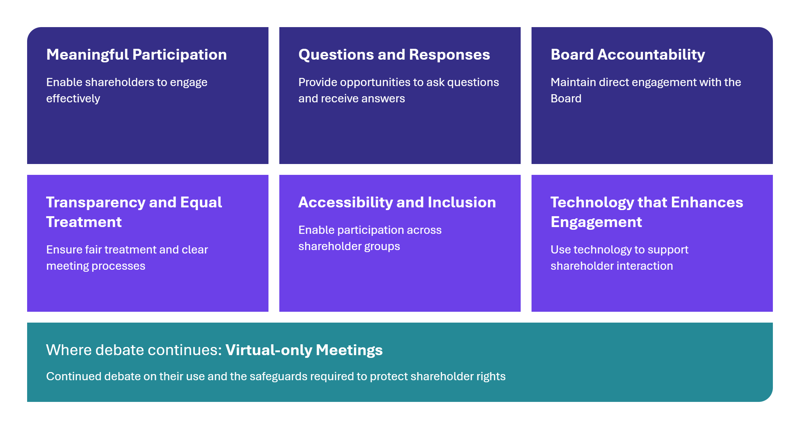
Current investor and proxy adviser policies identify a number of common themes, despite differing views on the circumstances in which virtual-only meetings may be appropriate.
While positions vary, many policies place emphasis on shareholder participation, transparency and accountability regardless of meeting format. Hybrid meetings continue to receive widespread support where shareholders can engage effectively with boards and exercise rights equivalent to those available at an in-person meeting.
Common Themes Across Current Policies
Common themes identified across investor and proxy adviser policies include:
Policy and Regulatory Direction
The discussion around virtual shareholder meetings is being shaped by policymakers, investors, governance bodies and companies.
In September 2026, the UK Government launched its Modernising Corporate Reporting consultation, which includes proposals to clarify the legal position of fully virtual AGMs. While the consultation highlights the potential benefits of virtual meetings, including improved accessibility and reduced administrative burden, it also seeks views on the safeguards that may be required to support them. Importantly, the outcome of the consultation remains uncertain, with responses being considered following the consultation's closure on 30 November 2026.
At the same time, the Investment Association's updated guidance provides a clearer indication of investor expectations. While recognising the role technology can play in broadening participation, the IA continues to express a preference for hybrid meetings and has introduced a series of safeguards designed to protect shareholder participation, transparency and board accountability.
Alongside these developments, the GC100 and the QCA have contributed to the debate through their own guidance and research. While approaching the issue from different perspectives, each recognises the opportunities presented by technology while emphasising the importance of maintaining effective shareholder engagement and appropriate governance safeguards.
Taken together, these developments illustrate the continued discussion around the role of technology in shareholder meetings, including differing views on meeting formats, shareholder participation and the safeguards that may be appropriate in different circumstances.
What Are Companies Actually Doing?
While policy discussions continue to evolve, market practice tells an important story.
A review of FTSE 100 AGM formats during the 2026 season suggests that physical meetings remain the dominant format.
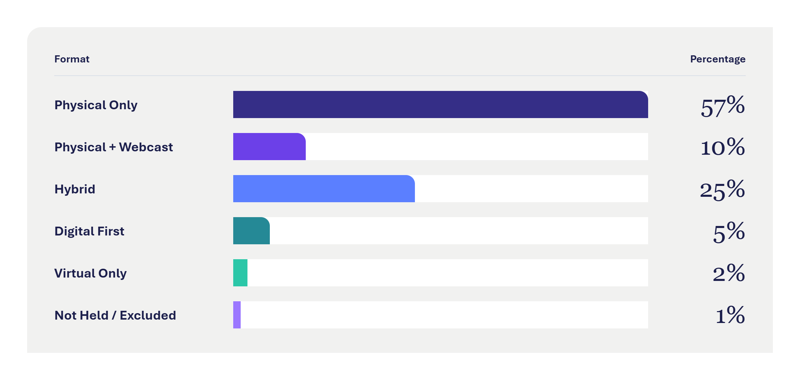
Three observations stand out:
- Physical meetings remain firmly established. When physical-only meetings, physical meetings with webcasts and hybrid meetings are combined, 92% of FTSE 100 companies continued to provide shareholders with an in-person attendance option during the 2026 AGM season.
- Hybrid meetings accounted for one quarter of FTSE 100 companies during the 2026 AGM season.
- Fully virtual meetings remain uncommon, despite the increased attention they have received from policymakers, investors and governance commentators.
The data demonstrates that a variety of approaches continue to be used across the FTSE 100, with physical meetings remaining the most common format alongside webcast, hybrid, digital-first and virtual meeting structures.
However, conversations with issuers throughout the AGM season, including discussions held during Equiniti's AGM Forum webinar, demonstrate why meeting format remains an active area of debate. Companies highlighted a range of practical considerations influencing their approach to AGMs, including shareholder attendance levels, internationally dispersed shareholder bases and differing experiences of engagement across both physical and virtual formats. In some cases, companies noted that low levels of participation were not limited to physical meetings, influencing ongoing assessments of the most appropriate format for their shareholder base.
These discussions also take place against the backdrop of a voting process where the majority of votes are typically submitted by proxy ahead of the meeting itself. As a result, many companies are considering how meeting formats can continue to support effective shareholder engagement while reflecting changing patterns of participation.
At the same time, issuers also highlighted the value of maintaining a physical AGM while noting the costs, venue requirements and, in some cases, security considerations associated with hosting shareholder gatherings. For some companies, the challenge is not whether technology should play a role, but how it can be used to balance accessibility, shareholder rights and accountability with practical operational considerations.
What Are We Seeing Across the Wider Market?
A broader review of AGM meeting formats presented during Equiniti's AGM Forum provides a longer-term perspective on developments across the UK market.
The analysis covers FTSE 100 and FTSE 250 companies between 2024 and 2026 and indicates that meeting format preferences have remained relatively stable over the period reviewed.
While physical meetings continue to be the most common approach, hybrid meetings represented a consistent proportion of meetings over the period reviewed and fully virtual meetings remained rare.
AGM Meeting Format Trends (2024–2026)
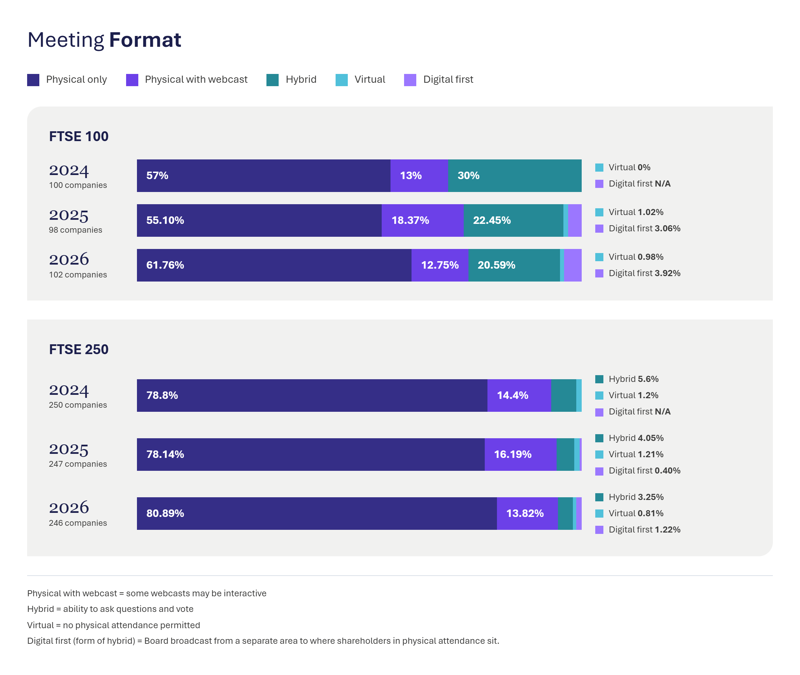
The trend data demonstrates that the AGM is evolving gradually rather than undergoing fundamental transformation. Technology is increasingly being used to broaden access and improve participation, while companies continue to retain many of the features associated with traditional shareholder meetings.
What Happens Next?
Physical and hybrid meetings remain the prevailing models in the UK today. However, the debate around AGM formats remains far from settled.
The Government's Modernising Corporate Reporting consultation remains open until 30 November 2026 and could provide greater legal clarity around the future use of virtual shareholder meetings. At the same time, investors and proxy advisers are expected to update their policies ahead of the 2027 AGM season.
Views continue to differ across companies, investors, proxy advisers and governance bodies. Stakeholders hold differing views on the role of technology in shareholder meetings, the extent to which virtual participation should be used and the safeguards that may be appropriate in different circumstances.
The data reviewed for this article highlights the variety of approaches currently being adopted across the market, as well as the practical considerations influencing those decisions. As the regulatory framework develops and stakeholder expectations continue to evolve, the debate around the future of the AGM is likely to continue.
Technology is expected to remain a key part of ongoing discussions about shareholder meetings, particularly as policymakers, companies, investors and governance bodies continue to consider its role and the safeguards that should accompany its use.
Rather than pointing to a single outcome, current market practice suggests that companies are continuing to assess how best to balance accessibility, engagement, accountability and operational considerations when determining the most appropriate meeting format for their shareholders.
Further Insight
Many of these themes were explored during Equiniti's AGM Forum webinar, which examined AGM participation trends, meeting format developments and evolving shareholder expectations across the UK market.
Watch the AGM Forum webinar recording to explore the data, trends and discussion in more detail, including perspectives from issuers on how meeting formats may continue to evolve.
You may also be interested in our Evolving Articles of Association: Key Trends from January 2023 to June 2026 - An Update Following The 2026 AGM Season article which explores how companies are adapting their constitutional frameworks, including provisions relating to shareholder meetings and evolving governance practices. The article highlights companies making amendments to allow a move toward hybrid and digital general meetings, with four companies proposing formalising digital or hybrid meeting formats in the first half of 2026. The question is, will this trend continue? We will continue our research to keep you informed.
Please reach out to your usual EQ contact if you would like to find out more about how EQ can support you to deliver the AGM format of your choice, both today and tomorrow.
Want a deeper view of the trends shaping the AGM landscape?
Watch our AGM Forum on demand to hear the full discussion from Equiniti’s experts, including the latest AGM trends, voting insights, industry developments, and considerations for future AGM seasons.