

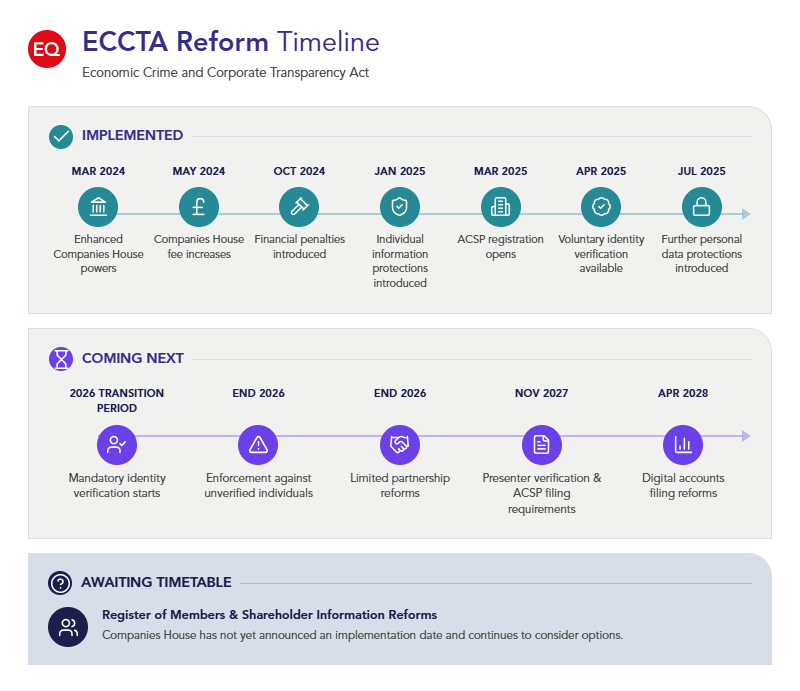
The revised transition plan does not include an implementation timetable for the ECCTA provisions relating to shareholder information and register of members reforms. Companies House states that it is still considering implementation options and has not yet confirmed a commencement date.
The key message from the updated plan is clear: the reform programme remains on track, but implementation is now spread over a longer period extending into 2028.
What Has Already Been Implemented?
A substantial proportion of the Act is already in force.
Since 4 March 2024, Companies House has gained new powers to query and reject suspicious filings, remove inaccurate information from the register, challenge misleading company names, improve registered office address requirements and share data more extensively with enforcement agencies. Companies have also been required to provide a registered email address and confirm that their intended activities are lawful.
Additional milestones have included:
- 1 May 2024: Companies House fee increases to support enforcement activity.
- October 2024: introduction of financial penalties for offences under the Companies Act and ECCTA.
- January and July 2025 saw the introduction of enhanced protections for individuals appearing on the register, including directors, PSCs and others whose personal details have been filed. Eligible individuals can apply to suppress residential addresses, signatures, business occupations and certain date-of-birth information from public disclosure.
- March 2025: launch of the Authorised Corporate Service Provider (ACSP) registration regime.
- April 2025, individuals, including directors and PSCs, were able to voluntarily verify their identity ahead of the introduction of mandatory verification requirements.
Identity Verification: The Most Important Change
Identity verification remains the centrepiece of the reforms.
Earlier Companies House communications suggested that mandatory identity verification would commence in autumn 2025. The updated transition plan now confirms a specific implementation date of 18 November 2025. From that date:
- all new company directors must verify their identity;
- all new Persons with Significant Control (PSCs) must verify their identity; and
- identity verification becomes a compulsory part of incorporation.
- Importantly, 18 November 2025 also marks the start of a 12-month transition period for existing directors and PSCs. During this period, verification will be completed through the company's confirmation statement process.
Key Change: Enforcement Against Unverified Individuals Expected by the end of 2026
One of the most notable timetable developments is the revised expectation regarding completion of identity verification across the register.
The updated plan states that Companies House expects to complete the transition period and commence enforcement action against unverified individuals "by no earlier than the end of 2026."
The timetable change relates primarily to the completion of the transition exercise and the commencement of compliance and enforcement activity, rather than extending the period available for directors and PSCs to verify their identities. Existing directors and PSCs will still be expected to verify during the 12-month transition period beginning on 18 November 2025, with enforcement against those who remain unverified expected no earlier than the end of 2026
This represents a more cautious implementation timetable than first anticipated. It reflects the practical challenge of verifying more than seven million individuals and integrating verification processes across Companies House systems, professional intermediaries and companies themselves.
Limited Partnership Reform Moves to Late 2026
Another implementation clarification concerns the reform of UK limited partnerships.
The transition plan confirms that enhanced transparency requirements for limited partnerships will take effect no earlier than the end of 2026. These reforms will require additional information to be filed and maintained, improving visibility of ownership and control structures.
Presenter Verification and ACSP Requirements Postponed Until 2027
Perhaps the most consequential timetable adjustment for professional advisers is the confirmation that verification obligations for those filing documents will not arrive before November 2027.
By no earlier than November 2027:
- identity verification will become compulsory for document presenters;
- third-party agents filing on behalf of companies will need to be registered as ACSPs; and
- Companies House will provide at least six months' advance notice before implementation.
This gives company secretarial providers, law firms, accountants and professional service firms additional time to prepare their systems and regulatory frameworks.
Major Accounts Filing Reforms Delayed Until April 2028
Another substantial extension to the phased rollout concerns accounts filing reform.
Companies House now confirms that the new accounts regime will commence in April 2028, providing businesses with approximately 21 months to prepare.
The reforms will include:
- mandatory software-only filing of annual accounts;
- compulsory filing of profit and loss accounts by small companies and micro-entities;
- removal of abridged accounts;
- strengthened audit exemption statements;
- filing of all account components together; and
- tighter rules around shortening accounting reference periods.
What Could Company Secretaries Be Doing Now?
While several implementation dates have moved further into the future, organisations should use the additional preparation time to review director and PSC data, consider identity verification processes, assess the potential impact of future accounts filing reforms and evaluate whether any service providers will require ACSP registration. The direction of travel remains unchanged, even if implementation is now expected to continue through 2028.
Summary
The revised ECCTA transition plan confirms that Companies House is continuing to implement the Act through a phased programme extending to 2028. While many reforms are already in force, key measures relating to identity verification, limited partnerships, presenter verification and accounts filing will be introduced over the next two years. The most significant near-term change remains the commencement of mandatory identity verification on 18 November 2025, with enforcement against unverified individuals expected no earlier than the end of 2026.
Notably, Companies House has not provided a timetable for the shareholder information and register of members provisions, which requires secondary legislation to be passed, leaving an important element of the reform package outstanding. Overall, the updated timetable provides greater certainty on implementation dates, while offering companies and their advisers additional time to prepare for the changes ahead.
The full Outline Transition Plan is available here: Economic Crime and Corporate Transparency Act: outline transition plan for Companies House - GOV.UK
Need help navigating ECCTA?
Please reach out to your Relationship Manager who will be able to assist further, or find more information on our dedicated ECCTA Hub.