

In this article we review Stage 4 – Communicating Redress Outcomes, which sets out how firms need to inform consumers of the results of their investigations and go about paying any redress due. Customers also get the opportunity to challenge these findings, so firms need to be ready to handle further investigations if the consumer provides evidence they believe contradicts the firms results.
Redress Outcomes Stage Overview
When firms conclude their liability assessments and calculations, they must send provisional decision notifications to customers, setting out whether redress is due or not. This provisional decision must include the reasoning behind the decision and set out the evidence used to reach this decision. This is true both for customers that are due compensation and those that are not.
This step must be done within 7 months of the scheme starting for customers with an existing complaint, and within 15 months for other identified agreements.
Once this notification is sent, customers who wish to contest the decision have one month to respond and provide evidence supporting their counter claim. Lenders will then have two months to review this additional evidence before reaching their final decision and sending a final redress determination to the customer.
If the customer does not contest the provisional decision within one month, firms will send out the final redress determination that matches the provisional notification.
Payment of any redress needs to be completed within one month from the date of the final redress determination. Beyond this point the redress would become a recoverable debt and would attract additional interest on the total redress payment at 8%. This requirement makes it critical that lenders have payment instructions from their customers well ahead of issuing the final redress determination.
Summarising the 4 Key Stages – Timelines and Customer Journeys
The fact that firms need to be sending provisional redress decisions to the thousands of customers already in their systems within 7 months from the scheme start date really drives home the scale of the challenge facing lenders. They need to get to this stage within 15 months for claims that are identified (either by the lender or consumers) after the scheme starts.
Planning the entire customer journey before those journeys start in the new year is vital. We’ve covered in steps 1,2 and 3 what should be considered for all communications, the assessment of liability and redress calculation. Now that you’ve issued the provisional and then final redress decisions, the final step is making the payment to customers.
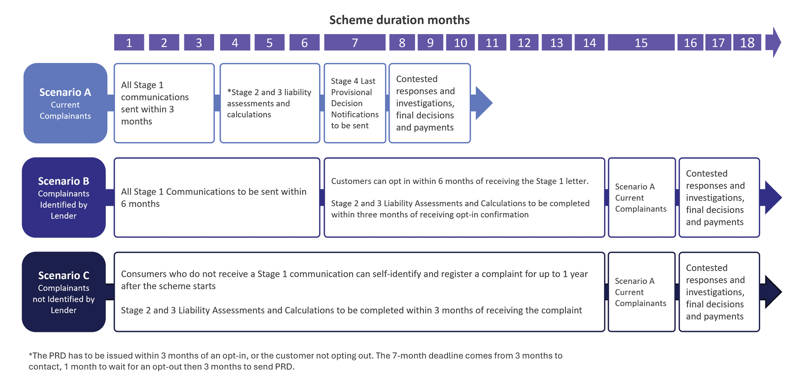
At EQ, we are actively working with lenders to put all these steps in place, frequently taking on the whole journey as a fully managed service. Based on this experience, we have put together a timeline summary using the following complainant scenarios:
- Customers with existing complaints already submitted to lenders at the point the scheme starts
- Customers who opt in to the scheme because of communications from the lender
- Customers not yet approached by the lender but who submit a complaint after the scheme starts
Scheme Milestone and Deadline Summary
The diagram below gives a high-level indication of the different streams that lenders must manage simultaneously, bearing in mind that customers will be responding at different times throughout the time blocks given. The Stage 4 processes may well be depending on lender capacity and when the customer either responds to communications or gets in contact for the first time.
Planning and Managing the Process
Planning the entire sequence of the customer journey for all four stages needs to be undertaken before the first communications are sent which starts the clock ticking. Solution capabilities such as tracking mechanisms, investigation capacity, calculation tools, print and mail requirements and payment systems all need to be lined up before Stage one begins.
Lenders should have the confidence that each stage of the process is in place and will be ready when needed throughout the customer journey. This means having the technology and people required to fulfil each step ready to go when the Scheme starts – currently expected in February/March 2026 – and certainly before any initial communications are sent.
Planning the sequencing of these different cohorts and processes will need to be managed simultaneously throughout the lifecycle of the claims, presenting a scheduling and capacity challenge for the duration of the programme.
Engaging a partner with all these capabilities
EQ Customer Resolutions has a fully end-to-end solution ready to go that can manage each stage of the redress process, delivered with expert consultation, detailed design, technology, automation and resource.
Whether you need us to handle the entire programme as a fully managed service, or work with your internal teams to deliver it, we can support every step of the way.
Our solution can:
- Identify all relevant in scope agreements and the treatment needed to redress each case.
- Automatically trace customers you have lost contact with.
- Automate all customer communications and responses, including recorded delivery mail and digital channels.
- Receive opt-ins, opt-outs and payment instructions using a secure customer portal with your branding.
- Manage workflows that ensure adherence to the FCA timelines without relying on users to action tasks on time.
- Build intelligent automation to increase efficiency reduce resource cost and improve quality while minimising risk.
- Digitally assess liability on cases reducing the volume that will require manual review.
- Generate accurate calculations on demand through direct integration to our calculation capability.
- Issue redress determinations and manage responses.
- Automate final redress payments to the customer after digitally completing necessary KYC and ID&V checks.
Get in touch to discuss how we can support you to manage the entire compensation and redress process.
Four stages made clear
In this series, EQ is outlining what firms need to prepare and consider as part of each of the four scheme steps:
Stage 1 – Identification of scheme cases and consumer consent – Firms to undertake checks to identify if customers are excluded or included in the scheme to and communicate this to their whole customer base.
Stage 2 – Liability assessment – Firms to assess if they are liable to pay redress to each customer.
Stage 3 – Calculation of redress – Firms to calculate the total amount of redress for each affected customer.
Stage 4 – Communicating redress outcomes – Firms to send out the final redress determination letter to consumers and pay all necessary redress.