

When market infrastructure shifts, share plans feel the impact quickly. Digital ownership, faster settlement and potential reform of all-employee plans are moving from policy discussion towards practical decisions.
Briefing host, Bryony Wilson shares this quarter’s hot topics
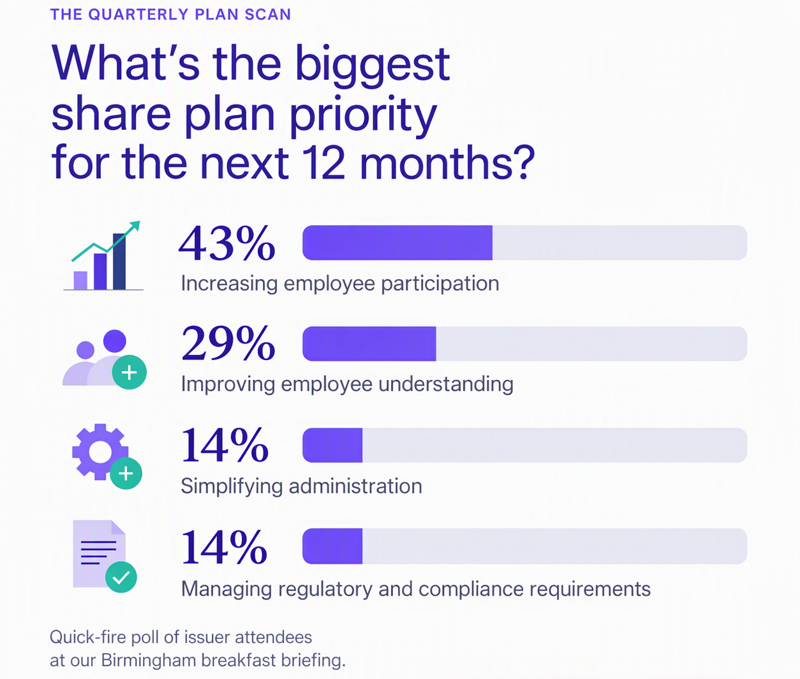
At the latest breakfast briefing in our series, share plan professionals joined the Equiniti team and reward experts from Deloitte at The Ivy in Birmingham to discuss the issues moving up issuers’ agendas.
Held on 22 October under Chatham House principles, the briefing brought together 10 attendees, including representatives from listed companies, an employee-owned business, administrators and legal experts.
Three headlines in 30 seconds
Dematerialisation is no longer hypothetical.
Four issuers around the table still issue paper certificates following SAYE maturities. Their focus is now on the digital alternatives and how to bring participants through the change.
T+1 is understood, but practical work remains.
Attendees appeared well prepared for the change. One company has already enhanced its settlement process by agreeing a letter of authority between its administrator and EBT provider.
Participation depends on relevance, not simply reach.
Experiences ranged from SAYE participation above 65% to persistent challenges engaging younger, part-time and frontline workers. The most useful discussion focused on who delivers the message, when it lands and whether employees understand what they are being offered.
What we’re hearing
1. Dematerialisation: disbelief is giving way to action
After years of discussion, attendees initially questioned whether dematerialisation would happen. The formal implementation work now under way shifted attention to identifying where participant journeys still produce paper certificates and what alternatives should be available going forward.
Four issuers at the briefing, particularly those operating SAYE, still issue certificates following maturity.
A certificate received through their share plan may be an employee’s only certificate. Companies will need to explain the alternatives to holding shares, how participants can access them and whether their rights or choices will change.

The immediate actions are clear:
- identify which vesting and maturity journeys provide a choice to receive certificates;
- agree the replacement route(s) with administrators and registrars;
- test the implications for different participant groups; and
- use existing invitation, maturity, vesting and leaver communications to prepare participants for the change.
2. T+1: remove the middleman
The UK moves to T+1 settlement on 11 October 2027, cutting the standard settlement period for securities transactions from two business days to one. The Financial Conduct Authority expects firms to be making system and process changes now and to be ready to test them in early 2027.
One company provided a practical example. It had recently put in place a letter of authority allowing its share plan administrator to engage directly with its EBT provider when shares are needed for settlement.
Previously, the administrator contacted the company, which instructed the EBT provider to respond. The authority removes this step while keeping the company informed.

Companies preparing for T+1 should check for:
- instructions that pass through parties and whether delegating authority would streamline the process;
- manual steps that depend on a particular individual;
- late decisions about sourcing shares or cash;
- unclear responsibility between administrators, brokers, trustees, custodians and registrars; and
- processes that have not yet been tested end to end.
3. Participation: start with the workforce, not the campaign
The latest ProShare SIP & SAYE research presents an encouraging market picture. Based on 2025 data, it recorded 304 companies with live SAYE plans, up 4.8%, while overall SAYE participation rose from 31.99% to 38.95%. Simultaneously SIP schemes have enjoyed record partnership contributions.
One financial services business reported SAYE participation above 65%. The strength of that engagement has prompted it to consider introducing a SIP, creating another route for employees to become shareholders.
A hospitality employer struggled to engage its predominantly pub-based workforce. Younger, part-time employees and those combining work with study may miss head-office communications or see little value in a three-year plan if they do not expect to stay with the company.

The conversation produced several practical ideas:
- equip pub or area managers to explain SAYE during existing team briefings;
- provide simple manager packs rather than relying solely on central communications;
- use attention-grabbing materials, such as a staff beer mat carrying a QR code;
- stagger the timing of invitation messages to reflect shift patterns;
- use a mobile share plan app to make information easier to access; and
- explain SAYE throughout the year, not only during a short invitation window.
At one company, the deputy company secretary joined team meetings to explain what a share is, what affects its price and how SAYE works. Employees could ask questions without feeling they should already know the answers.
Companies need to consider who employees trust, when they are receptive and what they need explained to make a confident decision.
Expert view: three legal issues moving up the agenda

Juliet Halfhead
Senior Partner, Deloitte

Matt Stears
Associate Director, Deloitte
Hybrid plans: interest without first-mover confidence
Hybrid executive plans remain a minority approach, but interest is growing as UK-listed companies consider how to compete for international talent.
The questions from the room were largely hypothetical. Attendees wanted to understand how some companies had adopted hybrid structures and how the wider market was responding, rather than discussing immediate plans of their own.
The discussion suggested a degree of first-mover hesitation. Companies appeared interested in the direction of travel but cautious about moving before a clearer market practice has developed. Adoption is currently more visible in the FTSE 250, with further growth anticipated.
Any company considering a hybrid plan will still need a clear rationale covering the balance between performance and restricted shares, award quantum, vesting and holding periods, and expected shareholder reaction. Following the market will not, on its own, provide a convincing case for change.
Unfair dismissal: equity awards could increase the exposure
From 1 January 2027, the qualifying period for ordinary unfair dismissal will fall from two years to six months and the compensatory award cap will be removed.
The government has confirmed that compensation will continue to be based on actual and projected losses evidenced by the claimant. Removing the cap does not make awards automatically unlimited. It does, however, increase potential exposure where a claimant can demonstrate substantial losses.
For senior employees, those losses could include salary, bonuses, benefits and equity awards. Questions may also arise around awards that were forfeited on dismissal and, depending on the evidence, future awards that an individual expected to receive.
Senior departures may involve private board-level conversations and negotiated exits rather than the formal performance and dismissal processes used elsewhere in an organisation. Removing the cap makes documentation, fairness and consistency more significant.
Companies should review share plan rules and employment processes together, including the treatment of leavers, the use of discretion, award acceptance, vesting provisions, and malus and clawback.
The full impact will become clearer only once claims are brought under the new rules and tribunals begin to establish how they apply to complex remuneration packages.
NED share ownership: alignment without unnecessary complexity
NED share ownership is also attracting attention as companies look for stronger alignment between directors and shareholders.
Direct share awards can create additional legal, governance and shareholder approval considerations because NEDs are not employees. In some cases, companies may be able to achieve the intended outcome more simply through ownership guidelines or an expectation that NEDs invest a proportion of their cash fees in shares.
The Plan Scan watch list
Autumn Budget: EMI2 expansion, but no new SAYE or SIP reforms
The Budget expands CSOP, now known as EMI2, with the individual option limit doubling to £120,000 from 6 April 2027. EMI and EMI2 will operate independently, alongside greater EMI flexibility and simpler reporting. There were no substantive new reforms to SAYE or SIP.
Watch for: implementation guidance ahead of April 2027 and any further moves to modernise SAYE and SIP.
T+1: Testing becomes the next milestone
T+1 is moving from planning into delivery. The Financial Conduct Authority expects firms to be ready to test system and process changes in early 2027, and a joint UK, EU and Swiss testing framework has been published.
Watch for: whether complete share plan transaction chains, including third-party providers, are ready to move into testing.
Unfair Dismissal: The first cases will matter
From 1 January 2027, the cap on unfair dismissal compensation will be removed. For share plans, the key unknown is how tribunals will treat equity awards and other long-term incentives when assessing losses.
Watch for: the first cases involving bonuses, LTIPs or other equity awards and what they reveal about the potential exposure around senior employee exits.
Looking ahead
The Equiniti breakfast briefing series will continue in 2027, with events being considered in London, Scotland, Manchester and the Midlands.
Interested in joining a future briefing? Register your interest and tell us which location would work best for you.