

The two sources should be read together. HMRC’s figures, drawn from Employment Related Securities returns, provide the national picture across all four tax-advantaged schemes for the tax year. ProShare’s survey gives a closer view of how SIP and SAYE operate at company and participant level over the previous calendar year. In simple terms, HMRC shows the scale; ProShare helps explain the behaviour behind it.
What’s clear is that tax-advantaged share plans remain a durable part of UK reward, but the numbers need to be interpreted through the lens of scheme cycles, tax changes and corporate events. A single year rarely tells the full story.
The headline position
In tax year 2024-25, HMRC estimates that UK employees were granted options or invested in their employers’ shares to a value of £3.87 billion through tax-advantaged share plans and made an estimated £1.23 billion in Income Tax and National Insurance savings. The number of companies with tax-advantaged schemes rose slightly to 20,650. SIP and SAYE remained broadly stable, while CSOP and EMI adoption increased slightly.
The overall HMRC relief figure was lower than the previous year, but that movement is better read as a function of timing and scheme dynamics than as evidence of weakening demand. ProShare’s survey points in the same direction: companies included in the survey with live SAYE plans rose 4.8% to 304, while companies with SIP rose 10% to 474. Employers are not stepping away from these plans.
SIP: growth across every element
The initial value of shares put into Share Incentive Plans rose to £1.21 billion in HMRC’s figures, with increases across every SIP element. Employees are investing more in this long-term ownership vehicle than ever before: partnership values have risen as both the number of purchases and their average value has increased; and dividend shares reached their highest initial values since SIPs were introduced in 2000. Matching share valuation reached close to an all-time high (£280m) – beaten narrowly by a spike in 2014-5 (£310m). Free shares remain strong too, although their historic high remains 2013-14, following the Royal Mail flotation and one of the largest all-employee SIP free share awards made in the UK.
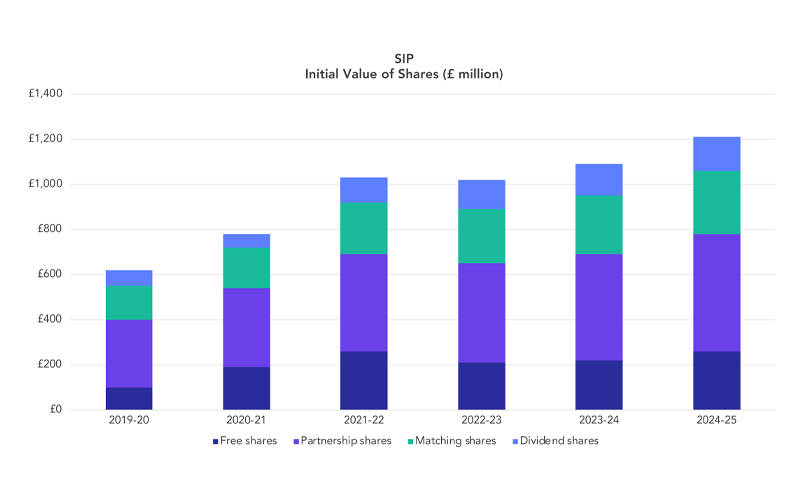
Free shares deserve particular attention. The number of employees receiving awards rose to 360,000, above the 10-year average of 276,000, with a combined initial value of £260 million. That is close to the level last seen after the COVID period, when many employers used tax-advantaged free shares as broad-based recognition and retention awards for employees who had supported the business through the pandemic.
The 2024-25 increase appears to have a different character. Several large employers made significant awards designed to align the wider workforce with company performance or strategic milestones. A Financial Times article in September 2025 cited awards by Barclays, Rolls-Royce, Babcock and Aviva, with stated motivations ranging from rewarding financial recovery to marking a major acquisition and reinforcing shared ownership.
Dividend reinvestment is the second area to watch. The value reinvested in SIP dividend shares reached £150 million, the highest on record and well above the £60 million low recorded in 2020-21, when pandemic-related dividend reductions affected many companies. The number of dividend share purchases remained close to the prior year at 890,000, so the increase is principally a value story rather than a simple participation story.
That is worthy of note because reinvesting dividends within a SIP can be tax-efficient where dividend shares are held for the required period. Two policy and market factors are likely to have supported the rise in reinvestment values:
- The removal, from April 2013, of the £1,500 annual limit on reinvestment of cash dividends, which created greater reinvestment capacity for participants in mature SIPs.
- The reduction in the dividend allowance from £5,000 in 2017-18 to £500 in 2024-25, which has increased the number of participants for whom tax-efficient dividend reinvestment is relevant. EQ analysis of 400,000 SIP accounts found that, among participants receiving dividends above £500 in 2024-25, 71% invested in dividend shares.
ProShare’s survey adds the participant-level context. The weighted average SIP value per participant rose 8.4% to £6,871.45, and average monthly partnership share contributions rose 5.1% to £92.96. Matching also remains a mainstream design feature: 68.3% of companies offering partnership shares also offer matching shares, most commonly on a 1:1 basis.
One figure requires particular care. ProShare recorded a 95% increase in voluntary SIP withdrawals, to 299,528. That could indicate that more participants are accessing shares to meet personal financial needs, but ProShare also notes that improved reporting coverage may have contributed to the movement. Corporate events may also affect future data: following the June 2025 takeover of International Distribution Services, Royal Mail’s parent company, and the closure of its SIP, next year’s HMRC figures are likely to show an increase in the number of shares taken out of SIPs.
SAYE: read over the cycle
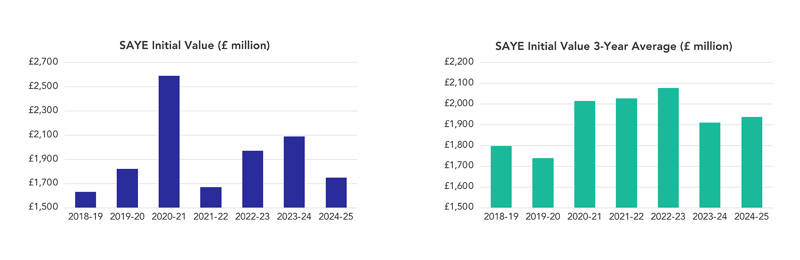
According to HMRC figures, £1.75 billion of SAYE options were granted in 2024-25, a value exceeding all other tax advantaged plans.
SAYE needs a longer read than a single year allows. Most participants save over three years, so the scheme naturally moves in cycles. During the pandemic, lower share prices drew more employees into schemes at reduced option prices; as share prices recovered and those schemes matured, many participants made substantial gains. That creates peaks and troughs in grant, exercise and savings data.
A rolling view is therefore more meaningful. On a three-year average, around 336,000 employees are granted SAYE options each year, with an initial grant value just under £2 billion and an average value of £5,737 per participant.
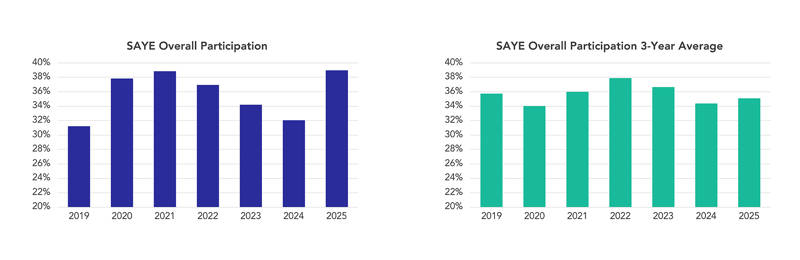
ProShare’s latest survey shows overall SAYE participation at 38.95%. On a three-year cycle basis, overall take-up since 2019 has generally sat in the 34% to 38% range, providing a more stable benchmark for employers than any single-year result.
Average monthly savings on new SAYE grants rose 5.1% to £114.36, while weighted average savings across all grants held broadly flat at £177.65. That suggests participants are continuing to support the scheme, even where affordability pressures limit further increases.
The most interesting behavioural signal is share retention. ProShare reports that 68% of exercising employees kept all their shares rather than selling immediately. Some of that may be linked to Capital Gains Tax planning, including transfers into ISAs where available, but it also points to a broader conclusion: for many employees, SAYE is not simply a savings product; it is a route into longer-term share ownership.
CSOP: settling after the limit change
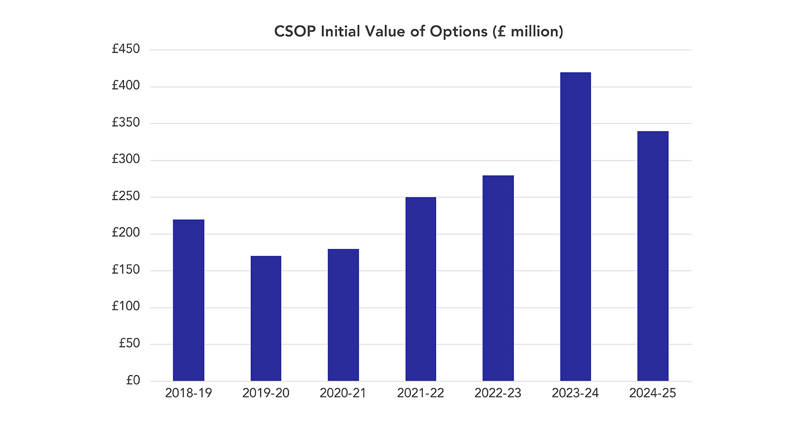
CSOP growth should also be read in context. The number of Company Share Option Plans has risen slightly since the individual option limit doubled from £30,000 to £60,000 in 2023. Grant values increased as companies used the additional headroom, particularly in 2023-24, and have since eased back while remaining strong at £340 million in 2024-25. That looks less like a downturn and more like normalisation after a policy change.
Looking ahead: the EMI expansion
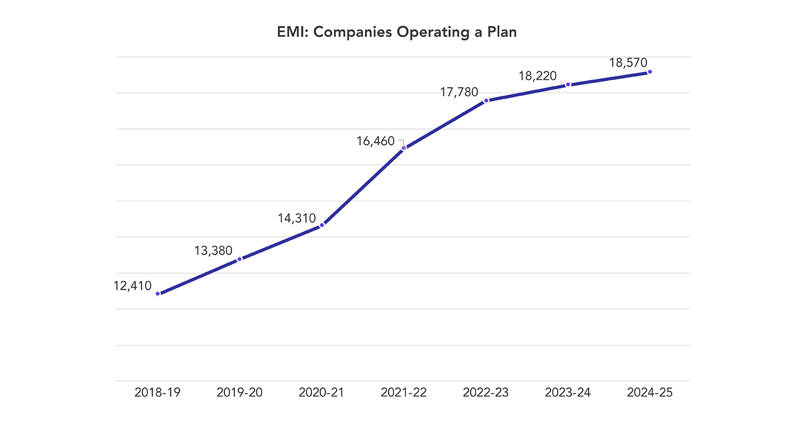
EMI is the area where future data may change most visibly. There are already more Enterprise Management Incentive plans than any other tax-advantaged plan, with HMRC reporting 18,570 schemes. The current HMRC dataset predates the EMI expansion effective from 6 April 2026, when qualifying thresholds rose significantly for most companies: gross assets from £30 million to £120 million, the employee limit from 250 to 500, the company-wide option pool from £3 million to £6 million, and the maximum exercise period from 10 to 15 years. The next few years’ statistics should show whether those changes widen access in practice.
What this means for employers
For employers, the practical implications are clear. SIP communications should revisit dividend reinvestment in light of the reduced dividend allowance, particularly for employees who may not realise the value of leaving dividend shares within the plan. SAYE performance should be reviewed over a three-year cycle, rather than judged on a single launch or maturity. CSOP and EMI design should be reassessed following recent policy changes. Across all schemes, employee education remains critical: the data shows continued engagement, but the opportunity is greatest where employees understand both the reward value and the longer-term ownership potential.
The story behind the numbers is therefore a positive one. HMRC shows the scale of tax-advantaged share plans; ProShare shows how employees are using them. Together, they demonstrate that broad-based employee share ownership continues to deliver substantial value and remains a proven, government-backed route to participation in corporate success. The challenge now is to keep SIP and SAYE relevant for the next generation of employees, while making fuller use of the renewed policy space around CSOP and EMI.
For further information on employee ownership please visit our Employee Share Plans page or get in touch to find out how we can support you.
FAQ
What is Save as You Earn (SAYE)?
SAYE is a UK tax advantaged employee savings scheme where participants save monthly and can choose at maturity whether to buy discounted shares or take their savings back.
What is a Share Incentive Plan (SIP)?
A UK tax advantaged employee share plan that allows employees to acquire shares through partnership, matching, free and dividend shares.
What is a Company Share Option Plan (CSOP)?
A CSOP is a UK tax advantaged discretionary share option plan that lets selected employees or directors buy company shares in the future at a fixed price, usually with no Income Tax or National Insurance on the gain if conditions are met.
What is an Enterprise Management Incentive (EMI)?
An EMI is a UK tax advantaged share option plan designed to help qualifying smaller and growing companies attract and retain key employees. It gives selected employees the right to buy shares in the future at a fixed price, with favourable tax treatment if the scheme conditions are met.
Where can I find further information?
Further information provided by HMRC can be found at: Tax and Employee Share Schemes: Overview - GOV.UK (https://www.gov.uk/tax-employee-share-schemes).
References
- Employee Share Scheme statistics - GOV.UK (data issued 3 July 2026, covering tax years to 2024-25)
- ProShare SIP & SAYE Survey 2026 (2025 data) Top 10 insights can be viewed here. ProShare members can access the full report, whilst non-members can purchase the report by contacting: team@proshare.org
- Reduction of the dividend allowance - HMRC policy paper, GOV.UK
- Reform of Company Share Option Plan - HMRC policy paper, GOV.UK
- Expanding the eligibility limits of the Enterprise Management Incentive scheme - HMRC policy paper, GOV.UK
- "Free employee shares make a perk of collective ownership", Financial Times, 28 September 2025
- Equiniti internal analysis of SIP and shareholder dividend data
- ids-annual-report-2024-25.pdf