

For share plan professionals, the headline development is the expansion and rebranding of CSOP as Enterprise Management Incentives 2 (EMI2). From April 2027, the individual option limit will double to £120,000, while EMI and EMI2 will be able to operate independently.
Alongside changes to EMI, the Budget also contains measures affecting the taxation and transfer of shares, ISAs and savings. Here are the key announcements, what they could mean for employers and the areas share plan teams should be considering now.
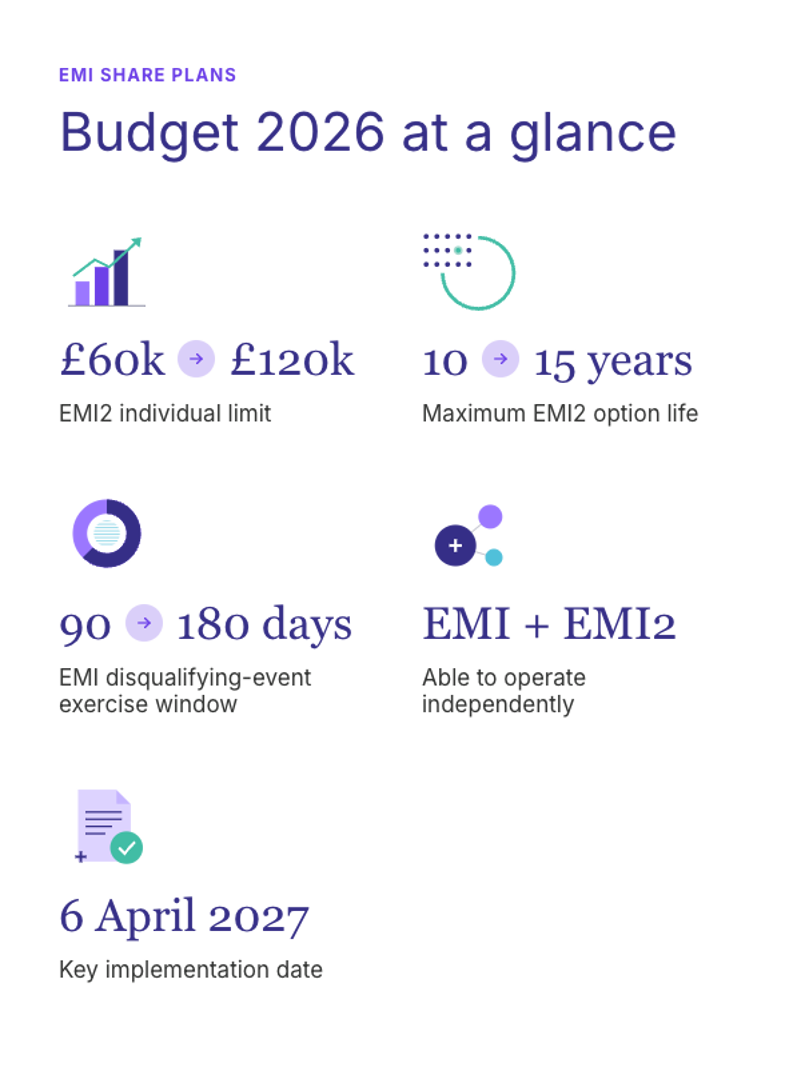
At a glance
- CSOP is being rebranded as EMI2, although CSOP will remain the name used in legislation.
- The individual EMI2 option limit will double from £60,000 to £120,000 from 6 April 2027.
- The maximum period over which EMI2 options can be exercised will increase from 10 to 15 years.
- EMI and EMI2 will operate independently, creating greater scope for eligible companies to use the two arrangements alongside one another.
- The EMI exercise period following certain disqualifying events will increase from 90 to 180 days.
- Separate notification of qualifying EMI grants to HMRC will be removed, with grants instead reported through the EMI end-of-year return.
- The Budget contained no substantive new reforms to SAYE or SIP.
- Wider changes to share taxation, transfer infrastructure and savings could also affect companies and share plan participants.
CSOP becomes EMI2: a more meaningful option for growing companies
One of the most significant employee share plan announcements is a major expansion of tax-advantaged Company Share Option Plans.
From 28 October 2026, CSOP will be known as Enterprise Management Incentives 2, or EMI2, reflecting its intended role as a tax-advantaged option arrangement for a wider range of companies, including businesses that have grown beyond EMI eligibility. CSOP will remain the name of the scheme in legislation.
From 6 April 2027, the individual EMI2 option limit will double from £60,000 to £120,000. The maximum period over which options can be exercised will also increase from 10 years to 15 years, giving companies greater flexibility when designing longer-term awards.
Another important change is the removal of the existing interaction between EMI and CSOP. From April 2027, the £120,000 EMI2 limit will operate separately from the EMI limit, under which eligible employees can be granted EMI options over shares worth up to £250,000 within a three-year period.
The two schemes will continue to have their own eligibility criteria, statutory limits and qualifying conditions, but the ability to use them independently could significantly increase their usefulness to employers.
For companies that qualify for both regimes, this creates greater scope to consider how EMI and EMI2 could work alongside one another. For businesses that have grown beyond EMI eligibility, meanwhile, the doubling of the EMI2 limit could make the arrangement a considerably more meaningful attraction and retention tool.
EMI: greater flexibility and simpler administration
EMI itself also receives a number of useful reforms.
The period during which an employee can exercise an EMI option following certain disqualifying events while preserving the relevant tax treatment will increase from 90 days to 180 days (HMRC's post-Budget policy paper and Employment Related Securities Bulletin 69 both confirm the 180-day period). The rules will also be amended so that companies transitioning to an Employee Ownership Trust structure can retain access to EMI.
There is also an important administrative simplification. From 6 April 2027, there will no longer be a separate requirement to notify HMRC each time qualifying EMI options are granted. Instead, grant details will be reported through the existing EMI end-of-year return.
For companies making regular EMI grants, removing a separate notification requirement should reduce administration and the risk associated with missing the relevant notification.
What should share plan teams do now?
Most of the principal changes do not take effect until 6 April 2027, giving employers time to assess their implications and prepare.
Assess the potential role of EMI2
Consider whether the increased £120,000 limit changes to EMI2 could fit within your overall reward strategy, particularly where the existing CSOP limit has constrained its usefulness.
Look at EMI and EMI2 together
For businesses eligible to use both, consider whether operating the arrangements independently creates opportunities to provide greater tax-advantaged equity participation across different employee populations.
Review plan processes and documentation
The April 2027 changes could have implications for plan rules, grant processes, exercise arrangements, internal controls and reporting calendars. The extended 15-year EMI2 exercise period may also be relevant when considering future plan design.
Prepare participant communications
Share plan changes can quickly become complex for employees. Companies should consider how and when they explain any changes to their arrangements, particularly where employees participate in more than one type of plan.
Keep implementation details under review
Further guidance and implementation detail will be important as April 2027 approaches. Share plan professionals should also keep a watching brief on the introduction of Securities Transfer Tax and any future reform of SAYE and SIP.
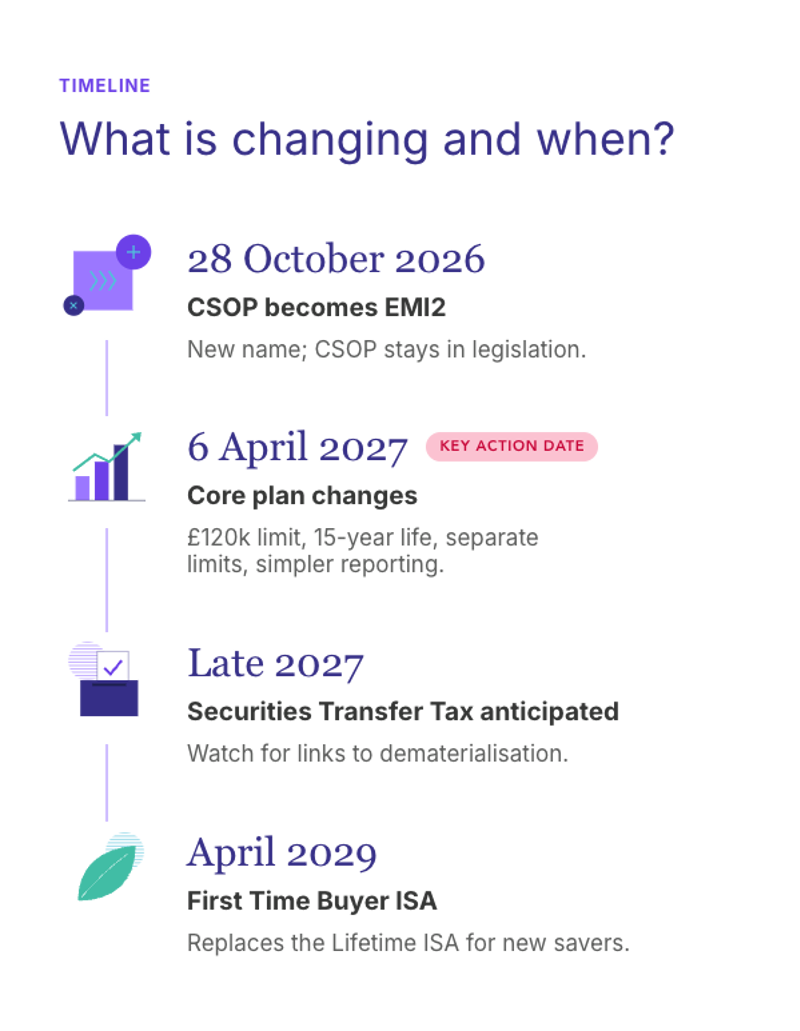
Key dates
28 October 2026
CSOP begins to be known as EMI2, while retaining the CSOP name in legislation.
6 April 2027
The £120,000 EMI2 limit, 15-year exercise period, separation of the EMI and EMI2 limits, extended EMI exercise window and simplified EMI reporting are due to take effect.
Late 2027
The new Securities Transfer Tax is currently anticipated to replace Stamp Duty and Stamp Duty Reserve Tax.
April 2029
A new First Time Buyer ISA is due to replace the Lifetime ISA for new savers.
Still on the watchlist: SAYE, SIP and market infrastructure
Some of the most interesting points for share plan professionals concern areas where further change could still follow.
Despite the Government publishing its response in November 2025 to the 2023 Call for Evidence on SAYE and SIP, there were no substantive new reforms to either of these important all-employee share plans in the Budget.
The review considered how SAYE and SIP could be improved and simplified, including barriers to participation and whether the schemes offer sufficient flexibility. The question of whether further modernisation will follow therefore remains open.
Securities Transfer Tax and dematerialisation
There was also no headline move to remove taxation on UK share transfers. Instead, the Government is continuing with plans to introduce a new Securities Transfer Tax (STT), replacing Stamp Duty and Stamp Duty Reserve Tax, with implementation currently anticipated for late 2027.
For companies, brokers, administrators and employee share plans involving market transactions, attention will turn increasingly to how the new regime will work in practice. The timetable and detailed implementation arrangements remain important areas to watch as the Government develops its plans.
The timing is also worth considering alongside the UK's wider move towards dematerialisation. While alignment between the STT timetable and the first stage of dematerialisation has not been confirmed, coordinating major changes to the infrastructure supporting UK share ownership could have clear operational advantages.
For share plan professionals, both developments reinforce the importance of looking beyond individual regulatory changes and considering their cumulative impact on administration, systems, processes and the participant experience.
Wider developments affecting shares, ISAs and participants
Beyond employee share plans, several Budget announcements could be relevant to companies and their participants.
Business Asset Disposal Relief
From 6 April 2027, the lifetime amount of qualifying gains eligible for Business Asset Disposal Relief will reduce from £1 million to £500,000. BADR currently provides a reduced 18% Capital Gains Tax rate on qualifying gains.
The change could be particularly relevant to founders, directors and employees with significant qualifying shareholdings who expect to rely on the relief when disposing of their shares.
ISAs and investment
The Government has retained the £20,000 annual Cash ISA limit, preserving the ability of individuals to place their full annual ISA subscription into cash.
At the same time, there is a continued policy focus on encouraging more people to invest. The Government plans to work with the investment industry to explore a new incentive for people investing in a Stocks and Shares ISA for the first time, although the detail has yet to be determined.
This sits alongside an increase in the tax rates applying to savings income from 6 April 2027. The rates will rise by two percentage points to 24% for basic-rate, 44% for higher-rate and 49% for additional-rate taxpayers. For people with significant savings outside tax-efficient wrappers, this potentially makes effective use of the ISA allowance even more valuable.
For share plan professionals, these developments are relevant to the wider participant journey. What employees do with shares or cash proceeds after a plan matures or awards vest can be as important to their longer-term financial outcomes as participation in the plan itself.
The Budget also introduces a new First Time Buyer ISA from April 2029, replacing the Lifetime ISA for new savers and providing a 25% Government bonus towards the purchase of a first home, subject to the scheme's limits.
Our perspective
For employee share plans, the overall direction is encouraging.
Expanding CSOP into EMI2 increases the capacity for companies to offer tax-advantaged share options. Doubling the individual limit to £120,000, extending the potential option life and allowing EMI and EMI2 to operate independently should make the arrangement more useful, particularly for growing companies that have moved beyond EMI eligibility.
For companies that remain within EMI, the changes are less about scale and more about flexibility and simplification, particularly through the streamlined approach to HMRC reporting.
There is still unfinished business. Further reform of SAYE and SIP remains an important question for the share plans industry. At the same time, the introduction of Securities Transfer Tax and the UK's transition towards dematerialisation mean share plan professionals will need to consider changes to the wider market infrastructure as well as plan-specific regulation.
But the broader policy direction is positive: encouraging more people to invest and creating more opportunities for businesses to share ownership with the employees who help create their value.
For share plan teams, the period before April 2027 provides an opportunity to look ahead: to understand how the expanded arrangements could support their reward strategy, identify operational changes required and ensure they are ready to communicate clearly with participants.